

The Row Size Numbers Made Simple: Margaux 10, 12, 15 and Beyond
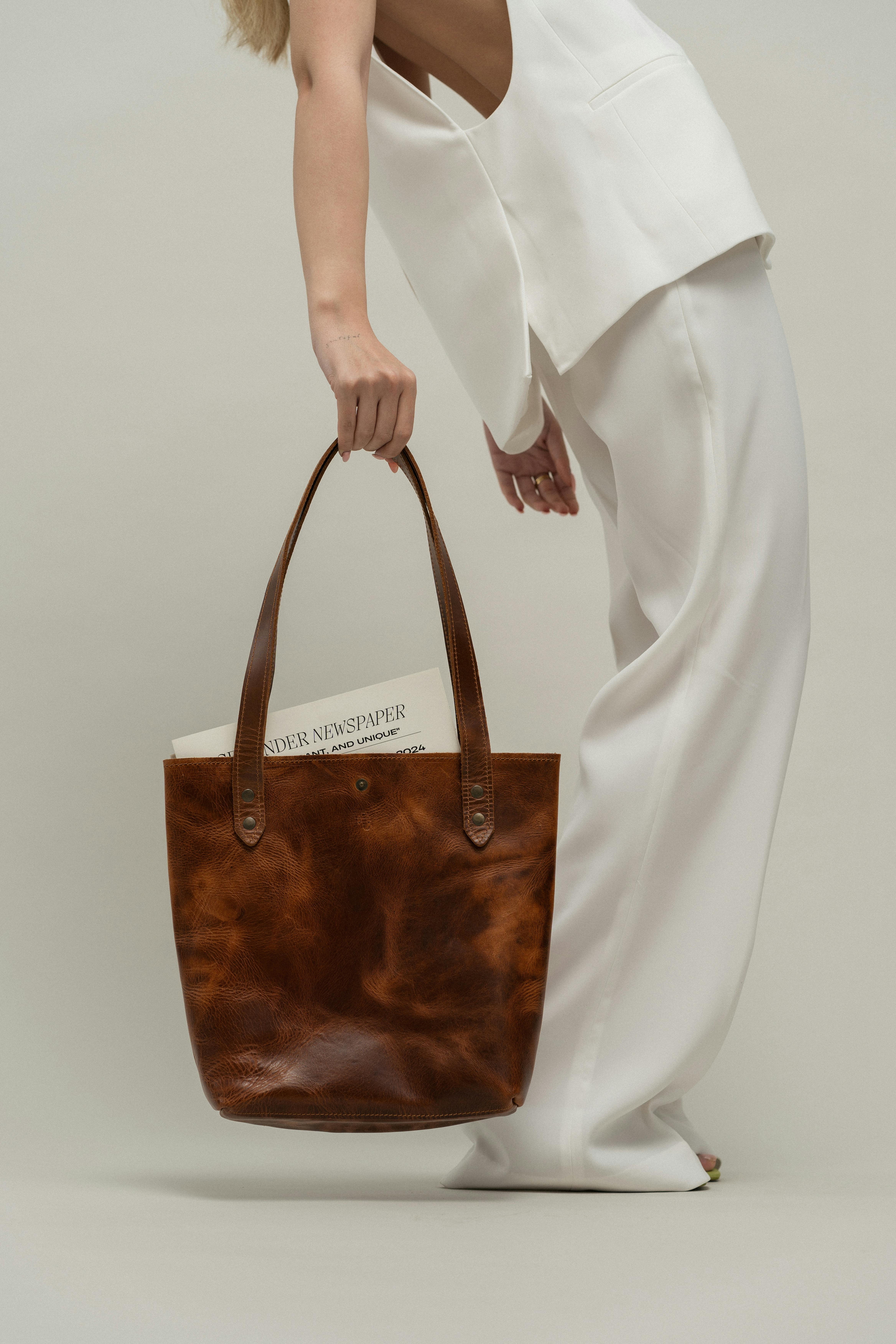
Adjectives are how most luxury houses label their sizes. You get a Mini, a Small, a Medium and, if the house is feeling expansive, a Jumbo, and none of those words amounts to anything you can measure. The Row does something quietly different across a large part of its line, and once you notice it the whole catalogue becomes easier to read. The number sitting in a model name is the bag’s width in inches. Margaux 10 measures ten inches across. Margaux 12 is twelve. That single fact is worth more in practice than any amount of styling copy, and it is the spine of this explainer.
The system runs further than the flagship alone. It reaches across Margaux 10, 12, 15 and 17, India 10.00, 12.00 and 15.75, Agnes 12 and 15, Sofia 8.75 and 10, and Marlo 12 and 14. Look at the decimals, since nobody writes 15.75 unless the figure is meant literally. What follows is how far the rule holds, where it bends, what the number leaves out, and how to turn it into a decision when you are choosing between two sizes of the same bag.
The rule, stated plainly
Read therowofficial.com/tote-bags the number in the name, add the word inches, and that is the width of the bag. That is the whole system, and it holds consistently enough across the numbered families to count as a rule rather than a fluke. The labelling is unusually honest, because the gap between what a size sounds like and what it measures simply closes. A Small from one house can be larger than a Medium from another, but ten inches is ten inches anywhere. For anyone measuring The Row bags against something already in the wardrobe, it turns the comparison into arithmetic rather than approximation. It also explains how the brand can run four sizes of a single silhouette without creating confusion.
| Model | What the size number means | Dimensions as published (W x H x D) |
|---|---|---|
| Soft Margaux 10 | 10 in | 10 x 7 x 7.5 in |
| Soft Margaux 12 | 12 in | 12 x 9 x 7.5 in |
| Soft Margaux 15 | 15 in | Width by name; measurements not listed |
| Margaux Shoulder 12 | 12 in as named | 14.75 x 9 x 5 in, which is the exception to the rule |
| Margaux 17 | 17 in | Given approximately as 17 x 12 x 9 in |
| India 10.00 | 10 in | Not published officially |
| India 12.00 | 12 in | No official figures published |
| India 15.75 | 15.75 in | Not listed officially |
| Agnes 12 | 12 in | Only the width, taken from the name |
| Agnes 15 | 15 in | Width from the name; nothing further listed |
| Marlo 12 | 12 in | Only the width, taken from the name |
| Marlo 14 | 14 in | Width from the name only |
| Sofia 8.75 | 8.75 in | Archive model; not listed officially |
| Sofia 10 | 10 in | Archive model; not listed officially |
What the number leaves out
Width is one dimension out of three, and the other two do not scale with it in any reliable way. Compare the two Soft Margaux sizes with official figures behind them: the 10 measures 10 x 7 x 7.5 in and the 12 measures 12 x 9 x 7.5 in. The depth stays identical at 7.5 inches, so the bigger bag is not a proportional enlargement of the smaller one. What moves is the height, up by two inches, and the width, up by the same. What that means in use is that a size up delivers a taller opening and more length rather than extra depth. Anyone assuming the 12 will swallow twice as much as the 10 will find the difference smaller than the numbers imply.
Handle drop holds steady too, at five inches on both Soft Margaux sizes, one more detail the model number keeps to itself. Five inches is a hand-carry or crook-of-the-elbow drop rather than a shoulder one, and both sizes ship with a removable shoulder strap to make up the difference. Fittings inside differ as well: a single card slot on the 10, while the 12 adds a second plus a zip pocket. Those details determine how a bag behaves day to day far more than an inch of width does. Use the number to place the bag on a scale, then read the specification to make sense of it.
The Margaux Shoulder 12, where the rule bends
One model in the current line bends the pattern, and that is worth stating clearly rather than quietly. The Margaux Shoulder 12 carries a twelve in its name, but the brand publishes its dimensions as 14.75 x 9 x 5 in. The width in the name and the width in the specification do not match, so the number is operating as a family size rather than as a literal external measurement on this one. That fits what the silhouette actually does, because it is a reworked shape with elongated tubular handles and narrowed gusseted side panels rather than a simple scaling of the tote. The lesson carries over: use the number as your starting point, then confirm against published dimensions before you commit. Where a listing gives no dimensions at all, treat the number as a pointer rather than a measurement.
What those widths actually hold
Translating inches into daily use is the step most guides skip. Under ten inches wide you are looking at a phone, cardholder, keys and lipstick affair, which is where the Sofia 8.75 and the small clutches live. Ten inches is the standard small day bag, enough for a compact wallet, a phone, sunglasses and a slim pouch without distortion. Twelve inches is the point where a bag begins absorbing a paperback, a small notebook, a folded scarf and a full-size wallet at once. Fourteen to fifteen inches is a working width, the point at which documents and a tablet stop being a squeeze. Seventeen inches, as on the Margaux 17, reads as a travel dimension rather than an everyday one.
- 8.75 to 10 in: evenings, quick errands and anything where the bag ought to disappear.
- 12 in: the most useful width in the line and the one most buyers settle on.
- 14 to 15 in: working days, commuting and the days you end up carrying other people’s things too.
- 17 in: travel and overnight use, where soft structure counts as a feature rather than a compromise.
Price follows width, though material moves faster
Size and price move together, though not as briskly as you might expect. Using observed 2026 market prices, the Soft Margaux 10 sits at $3,650 and the Soft Margaux 12 at $4,350, so two inches of width costs about $700. Marlo 12 has been observed at $3,600 and $4,900 depending on the version, with Marlo 14 at $5,300, a much larger step for the same two inches. Bigger jumps come from material than from size: India 10.00 is $3,850 in leather against $5,370 in suede, while Agnes 15 runs $5,000 in leather, $5,800 in suede and $4,300 in a canvas blend. With Agnes 12 at $4,400, the leather Agnes 15 is only $600 more for three additional inches. If you are optimising spend, choosing the material is the bigger financial decision, and choosing the width is the bigger practical one.
The bags that carry no size number
Plenty of the line falls outside the system, and confusion sets in when the two conventions get mixed. The Park Tote family trades in words rather than inches, running Small, Medium, Large and XL alongside the N/S Park Tote and Park Tote Three. Small bags such as the 90’s Bag, the Half Moon and the Bourse Clutch are named without any size marker. With those, dimensions are all you have: the Bourse Clutch is listed at 10.2 x 6.5 x 2.3 in, and the Half Moon is given officially as 8 x 13.5 x 2.5 in, with other listings differing enough that the figure is safest treated as approximate. Archive models follow no rule either, with the Camden measuring roughly 9 x 12.5 x 5.25 in despite having no number. The N/S and E/W prefixes are orientation shorthand, commonly read as north-south for taller shapes and east-west for wider ones.
Making the decision from the inches
The practical value of a literal sizing system is that it can be checked before you buy. Take a bag you already own and like, measure it, and set its width against the number in the model name you are considering. Do the same with the widest thing you routinely carry, be it a laptop, a folder or a water bottle, and add an inch of tolerance for the soft sides. Keep in mind that most of these are unstructured shapes, which is why a bag looks smaller empty and fuller in use than any flat measurement implies. When you are between sizes on a soft silhouette, the smaller one tends to look better and the larger one tends to do the job better. That trade-off, rather than the number itself, is the real choice in front of you when you buy row handbags in a numbered family.